

Understanding Neuromodulation: Guiding the Brain Toward Better Function
Neuromodulation is an increasingly discussed term in mental health, cognitive performance, and neuroscience. Most people’s minds jump to the extreme modality of electroconvulsive therapy (ECT) when hearing the term Neuromodulation, or neurostimulation. This can be far from what is being described. Understanding neuromodulation helps clarify how modern, evidence-informed approaches can influence brain function safely and non-invasively.
At its core, neuromodulation refers to methods that influence neuronal activity to improve how the brain regulates itself. These methods work by altering neural signalling, network balance, or cellular energy processes in ways that support healthier brain function.
The three primary categories of neuromodulation
Neuromodulation techniques generally fall into three categories.
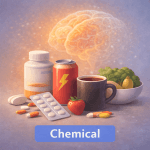
Chemical neuromodulation
This includes substances that influence neurotransmitters or neuromodulators in the brain. Examples include medications, nutrients, drinks and foods. These approaches act indirectly by changing the chemical environment neurons operate within.
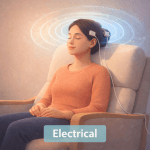
Electrical neuromodulation
Electrical approaches apply small, controlled electrical currents to influence neuronal excitability and communication. These methods range from highly invasive to non-invasive techniques used in clinical and research settings.
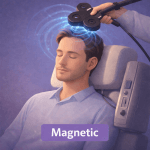
Magnetic neuromodulation
Magnetic approaches use electromagnetic fields to induce electrical activity within brain tissue. The best-known example is transcranial magnetic stimulation.
While all three categories influence brain function, they differ greatly in invasiveness, intensity, and clinical application.
Invasive and specialist-delivered neuromodulation
These approaches help illustrate the more intensive end of the neuromodulation spectrum. They provide useful context for understanding why many clinics, including ours, focus instead on lower-intensity, non-invasive methods that aim to support brain regulation with fewer risks and greater flexibility.
Some neuromodulation approaches require specialist medical oversight due to their intensity and risk profile.
Electroconvulsive Therapy (ECT)
ECT involves inducing a controlled seizure under general anaesthesia. It is typically reserved for severe, treatment-resistant depression and is delivered in hospital settings by specialist psychiatric teams. While ECT has strong evidence for specific indications, it also carries risks such as short-term memory disruption and requires careful medical management.
Transcranial Magnetic Stimulation (TMS)
TMS uses rapidly changing magnetic fields to stimulate cortical neurons. It is non-invasive but still requires specialist equipment, strict protocols, and trained medical oversight. TMS is most commonly used for depression and obsessive-compulsive disorder and has a growing evidence base supporting its use.
While these interventions can be effective, they are not what most people mean when discussing gentler or preventative neuromodulation approaches.
Non-invasive neuromodulation used in clinical practice
The majority of neuromodulation used at The Neurotherapy Clinic Victoria focuses on non-invasive, low-intensity approaches that aim to support brain regulation rather than override it.
Transcranial Direct Current Stimulation (tDCS)
tDCS applies a very low electrical current across the scalp to influence cortical excitability. Rather than forcing neurons to fire, tDCS subtly increases or decreases the likelihood that neurons will activate.
Controlled research demonstrates that tDCS can support aspects of attention, working memory, and learning when applied within established protocols (Kuo & Nitsche, 2012; Dedoncker et al., 2016). Large safety reviews and consensus guidelines consistently show tDCS to be well tolerated, with mild and temporary sensations such as tingling being the most commonly reported effects (Bikson et al., 2016).
Transcranial Alternating Current Stimulation (tACS)
tACS differs from tDCS by using a gently oscillating electrical current rather than a constant one. This oscillation allows tACS to interact with the brain’s natural rhythms, such as alpha or theta activity, which play an important role in attention, cognitive control, and how information is processed.
Rather than simply increasing or decreasing overall excitability, tACS has been shown to influence the timing and coordination of activity within and between brain networks. Experimental and human studies demonstrate that frequency-specific tACS can entrain neural oscillations and support more efficient network communication, particularly when stimulation frequencies are aligned with an individual’s EEG-measured brain rhythms (Antal & Herrmann, 2016; Helfrich et al., 2014).
Transcutaneous Vagus Nerve Stimulation (tVNS)
tVNS stimulates branches of the vagus nerve through the skin, most commonly at the ear or neck. The vagus nerve plays a key role in autonomic regulation, stress response, and emotional processing.
Research shows that transcutaneous vagus nerve stimulation can access central vagal pathways non‑invasively. Human imaging studies have demonstrated activation of core vagal relay regions and broader brain networks following auricular stimulation (Frangos et al., 2015), and concurrent taVNS/fMRI work has further described measurable neurophysiological effects and commonly used parameters (Badran et al., 2018).
In terms of function, reviews of the wider non‑invasive VNS literature describe potential benefits for emotional regulation and cognitive ageing, particularly when stimulation is paired with behavioural approaches such as cognitive training or therapy (Trifilio et al., 2023). As with other neuromodulation approaches, appropriate screening and adherence to established protocols are central to safety.
Pulsed Electromagnetic Field Therapy (pEMF)
pEMF uses very low-frequency electromagnetic fields to support how cells communicate and adapt over time. Unlike TMS, which is designed to directly stimulate neurons, pEMF operates at much lower intensities and works more subtly in the background, supporting regulation rather than driving activity.
Research on pEMF spans several domains. A detailed review by Ross and colleagues describes how PEMF can influence inflammatory signalling and cellular repair processes, which is one of the key ways it may support recovery and regulation in broader clinical settings (Ross et al., 2019).
On the cognitive side, early human studies have reported measurable changes in performance on tasks related to processing speed and reactive responding after transcranial PEMF exposure (Grigg et al., 2023). When applied within established clinical guidelines, pEMF is generally well tolerated and considered a low‑risk, supportive intervention.
Photobiomodulation
Photobiomodulation uses specific red and near‑infrared light wavelengths, each with different depths of penetration. For example, 660nm light is largely absorbed at the surface and is commonly used for skin-level applications, while 810nm is widely used in transcranial settings because it penetrates the scalp and skull more effectively and can reach cortical tissue. Longer wavelengths, such as 910nm and 1,060nm, are being explored for their potential to reach deeper brain regions.
When applied to the head, the goal is not to treat the skin but to support how brain cells produce energy. Near‑infrared light can reach the outer layers of the brain and interact with mitochondria, the cell’s energy producers. Rather than directly stimulating neurons to fire, photobiomodulation works more subtly by supporting brain energy and efficiency, which may help neural networks function more smoothly over time. Research has linked this approach to changes in cerebral metabolism and cognitive functions such as attention and memory (Hamblin, 2016; Salehpour et al., 2021).
The role of brain-based assessment
A critical part of using neuromodulation responsibly is having a clear understanding of what is happening in the brain in the first place. Rather than applying stimulation broadly and hoping for change, it is important to identify which brain systems may be underactive, overactive, or working inefficiently, and how this relates to day‑to‑day functioning.
Quantitative EEG (QEEG) and Event-Related Potential (ERP) assessments help provide this clarity. These assessments offer objective information about patterns of brain activity, network organisation, and how the brain processes information in real time. In practice, this can highlight differences in attention, regulation, processing speed, or cognitive effort that may not be obvious from behaviour or self-report alone.
When neuromodulation is informed by QEEG and ERP findings, it allows interventions to be selected and adjusted based on measurable brain function rather than symptoms in isolation. This helps guide more targeted, individualised decisions and supports a thoughtful, evidence-informed approach to care. The practitioner will then support you to understand neuromodulation protocols being recommended for you.
A regulated and supportive approach
Neuromodulation is not about forcing the brain to change. Used well, it is about creating the right conditions for the brain to learn, adapt, and regulate itself more effectively over time. In this sense, neuromodulation is often most useful when it is paired with principles from learning theory, where repeated experiences, feedback, and practice help reinforce healthier patterns of brain activity.
At The Neurotherapy Clinic Victoria, non-invasive neuromodulation sits within a broader therapeutic framework that includes assessment, education, and ongoing monitoring. Rather than being used in isolation, it is integrated with strategies that support learning and functional change, while ensuring safety, individual suitability, and meaningful day-to-day outcomes remain central to every decision.
If you are considering whether neuromodulation may be appropriate for you or your child; professional guidance and a clear assessment process are essential first steps.
References
Antal, A.,
& Herrmann, C. S. (2016). Transcranial alternating current and random noise
stimulation: Possible mechanisms. Clinical Neurophysiology, 127(1),
258–265. https://doi.org/10.1016/j.clinph.2015.03.012
Badran, B. W., Dowdle, L. T., Mithoefer, O. J., LaBate, N. T., Coatsworth,
J., Brown, J. C., DeVries, W. H., & George, M. S. (2018). Neurophysiologic
effects of transcutaneous auricular vagus nerve stimulation (taVNS) via
electrical stimulation of the tragus: A concurrent taVNS/fMRI study and
review. Brain Stimulation, 11(3), 492–500. https://doi.org/10.1016/j.brs.2017.12.009
Bikson, M., Grossman, P., Thomas, C., Zannou, A. L., Jiang, J., Adnan, T.,
Mourdoukoutas, A. P., Kronberg, G., Truong, D., Boggio, P., Brunoni, A. R.,
Charvet, L., Fregni, F., Fritsch, B., Gillick, B., Hamilton, R. H., Jankord,
R., Kirton, A., … Woods, A. J. (2016). Safety of transcranial direct current
stimulation: Evidence based update 2016. Brain Stimulation, 9(5),
641–661. https://doi.org/10.1016/j.brs.2016.06.004
Dedoncker, J., Brunoni, A. R., Baeken, C., & Vanderhasselt, M. A.
(2016). The effect of transcranial direct current stimulation on cognitive
control in depression: A systematic review and meta-analysis. Neuroscience
& Biobehavioral Reviews, 68, 238–256. https://doi.org/10.1016/j.neubiorev.2016.05.034
Frangos, E., Ellrich, J., & Komisaruk, B. R. (2015). Non-invasive
access to the vagus nerve central projections via electrical stimulation of the
external ear: fMRI evidence in humans. Brain Stimulation, 8(3),
624–636. https://doi.org/10.1016/j.brs.2014.11.018
Hamblin, M. R. (2016). Shining light on the head: Photobiomodulation for
brain disorders. BBA Clinical, 6, 113–124. https://doi.org/10.1016/j.bbacli.2016.09.002
Helfrich, R. F., Schneider, T. R., Rach, S., Trautmann-Lengsfeld, S. A.,
Engel, A. K., & Herrmann, C. S. (2014). Entrainment of brain oscillations
by transcranial alternating current stimulation. Current Biology, 24(3),
333–339. https://doi.org/10.1016/j.cub.2013.12.041
Kuo, M. F., & Nitsche, M. A. (2012). Effects of transcranial electrical
stimulation on cognition. Clinical EEG and Neuroscience, 43(3),
192–199. https://doi.org/10.1177/1550059412444975
Ross, C. L., Zhou, Y., McCall, C. E., Soker, S., & Criswell, T. L.
(2019). The use of pulsed electromagnetic field to modulate inflammation and
improve tissue regeneration: A review. Bioelectricity, 1(4),
247–259. https://doi.org/10.1089/bioe.2019.0026
Salehpour, F., Khademi, M., & Hamblin, M. R. (2021). Photobiomodulation
therapy for dementia: A systematic review of pre-clinical and clinical
studies. Journal of Alzheimer’s Disease, 83(4), 1431–1452. https://doi.org/10.3233/JAD-210029
Trifilio, E., Shortell, D., Olshan, S., O’Neal, A., Coyne, J., Lamb, D.,
& Williamson, J. (2023). Impact of transcutaneous vagus nerve stimulation
on healthy cognitive and brain aging. Frontiers in Neuroscience, 17,
1184051. https://doi.org/10.3389/fnins.2023.1184051
Grigg, M. R., Ulman, H. K., Gregg, M. K., Galster, S. M., & Finomore,
V. S. (2023). Effects of pulsed electromagnetic field on reactive
performance. NeuroRegulation, 10(3), 140–145. https://doi.org/10.15540/nr.10.3.140